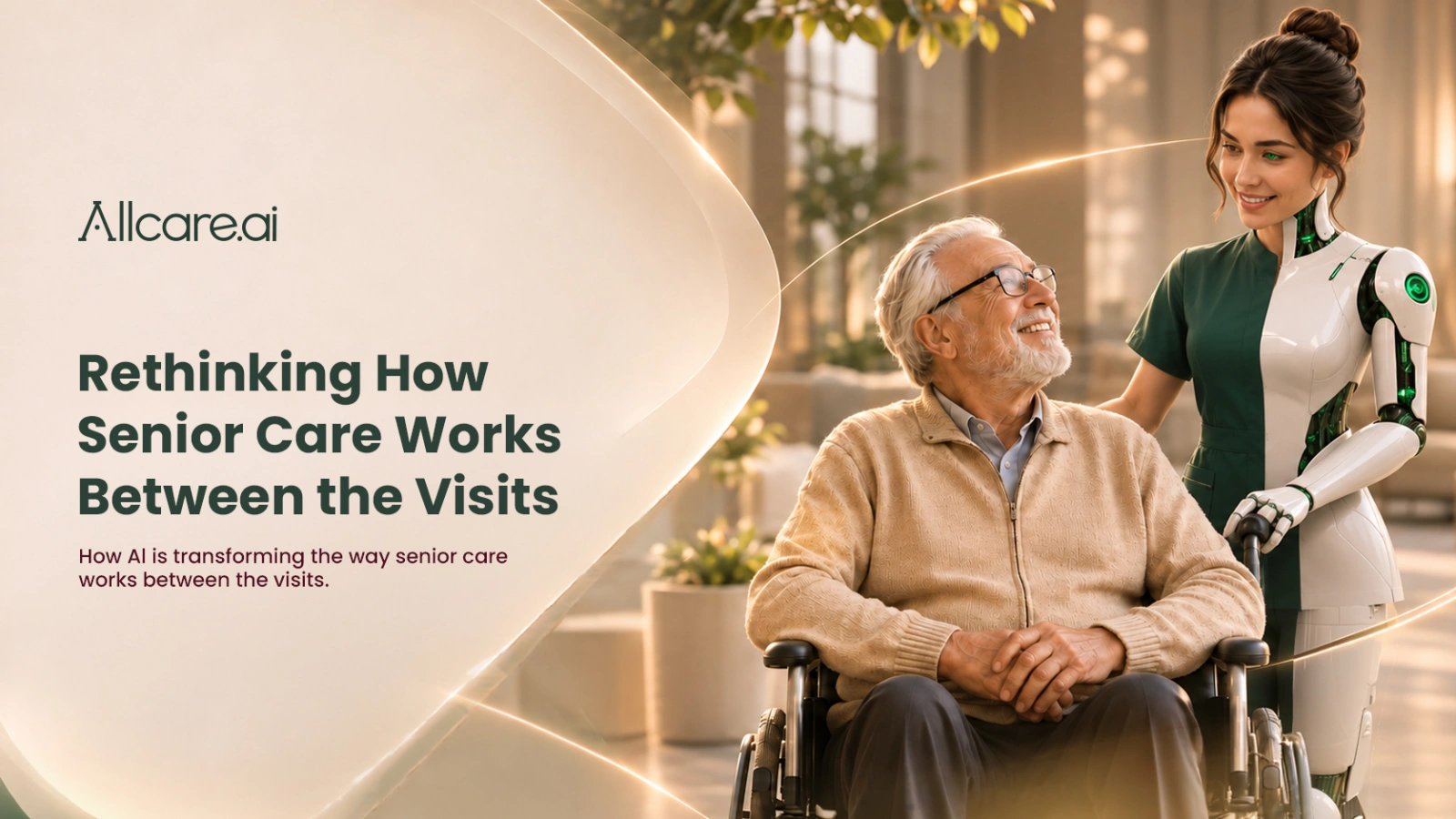
Self-Coordinating Care starts with a fairly simple idea, once a clinical decision is made, the work around that decision should not depend on somebody remembering to chase the next person.
A medication changes, the pharmacy needs to know, the facility needs the update, the record needs to stay current and someone needs to make sure the medication actually reaches the resident, a referral is placed, someone needs to schedule it, follow it and know whether it happened, a lab result comes back, somebody needs to make sure it reaches the right clinician and that whatever comes next actually happens, none of this is the clinical decision itself, but all of it determines whether that decision turns into actual care.
What Self-Coordinating Care means
This is what Self-Coordinating Care means at AllCare.ai, using AI and modern technology to help the work around care organize itself, move to the right people and stay visible until it is completed, while real people remain accountable for what happens next and licensed clinicians remain responsible for the clinical decisions themselves, the goal is not to make healthcare autonomous, it is to stop making people manually coordinate things that technology can coordinate far better.
What coordination looks like today
That distinction matters because senior care does not really have a shortage of individual systems, providers or communication channels, there are more of all of them than ever, what it often lacks is a layer connecting everything together, a resident in a senior living community may have a primary care physician, psychiatrist, podiatrist, pharmacy, diagnostic providers, specialists and the facility team all involved at the same time, every one of them can be doing their part properly and the overall experience can still be fragmented because nobody really owns everything that happens between them.
That is usually where the facility gets pulled in, the Executive Director, Wellness Director, nurse or another member of the team starts calling, emailing, faxing and following up, asking whether the doctor replied, whether the pharmacy received something, whether the appointment was scheduled, whether the result was reviewed and who is responsible now, after a while this becomes such a normal part of running a senior living community that it almost stops looking like a problem, it is just accepted as part of the work.
But there is a difference between providing care and manually carrying information between everyone providing that care.
Self-Coordinating Care is designed around that difference.
Where Allie fits
At AllCare.ai, our AI coordination layer, Allie, helps capture incoming requests and information, understand what needs attention, organize the work, route it to the appropriate team and keep the context around it connected, instead of relying on disconnected messages and somebody's memory to know what should happen next, a Care Partner remains involved and accountable for communication, follow-through and escalation, while providers, pharmacy teams and other clinical professionals continue doing the work that requires their expertise.
A medication change, step by step
A medication change is a good example because it looks simple until the entire workflow is visible, the clinician decides that something needs to change, which is a clinical decision and remains completely human, but that decision can immediately create several operational actions, the new order needs to reach the appropriate pharmacy, the medication record may need updating, the facility needs to know what changed, another medication may need to stop and somebody needs to know whether the process actually finished, the value of AI in this situation is not deciding what the resident should take, it is making sure the work created by the decision does not disappear somewhere between the different people involved.
The same idea applies to referrals, appointments, lab results, behavioral-health concerns, prescription questions, documentation and follow-up, senior care is full of these small events, individually they do not look particularly complicated but collectively they create a huge amount of operational work, especially when a facility is coordinating several providers across dozens of residents, and this is why simply adding another provider or another software product does not necessarily solve the problem, if the new service creates another isolated workflow, the facility may actually have more coordination to do than before.
Why AI, and why people still matter
This is also where AI becomes much more interesting than the way it is normally discussed in healthcare, because the useful part is not necessarily a chatbot or something that looks futuristic on a screen, it is the ability to continuously handle information at a scale people were never really designed to manage manually, maintaining context, recognizing that something still needs action, routing the work and keeping track of what remains open, people are much better used for judgment, relationships, exceptions, clinical expertise and the situations where someone genuinely needs another person.
In that sense, more technology does not have to mean less human care, it can actually mean the opposite, when Care Partners spend less time manually tracking routine tasks they can spend more time speaking with facility teams, handling exceptions, escalating something that needs attention or helping families understand what is happening, and when clinicians spend less time surrounded by coordination work they can spend more time focused on the clinical decisions they were trained to make.
Scaling across services and communities
This idea becomes even more important when different types of care start operating inside the same community, primary care, behavioral health, podiatry, pharmacy and diagnostics can all be available in one place and still feel disconnected if each operates through its own process, so the opportunity is not simply to bring more healthcare services into senior living, it is to make those services work as part of one connected care model, where information does not need to be manually carried from one team to another every time something changes.
And once the same thinking is applied across multiple communities the problem becomes even clearer, one facility may be able to operate through local relationships and informal workarounds because everyone knows who to call, but across a larger portfolio those workarounds become different processes, different vendors, different escalation paths and very different levels of visibility from one community to another, technology can help create a more consistent coordination layer without pretending that every resident, clinician or community should operate exactly the same way.
The direction we are building toward
That is ultimately what AllCare.ai is building toward with Self-Coordinating Care, not care without people and not AI making decisions that belong to clinicians, but a model where the huge amount of coordination happening around senior care becomes increasingly intelligent, connected and automatic, while accountability remains very clear.
Clinicians still practice medicine, facility teams still remain closest to the residents they support, Care Partners still own communication and follow-through, but the system around all of them gets much better at remembering what needs to happen, knowing where it needs to go and making sure it does not simply get lost along the way.
Because if technology can already help understand, organize, route and track this work, people should not have to spend so much of their day chasing it.
That is the idea behind Self-Coordinating Care, and it is the direction AllCare.ai is building toward.